
Priprema gradilišta (the name means “site preparation”) demolishes old houses, sheds and garages, digs foundations, pools, trenches and septic tanks, pulls stumps, levels plots and moves heavy machinery on an eight-tonne trailer. They are based in Bačka Topola and work across northern Bačka and Banat in Vojvodina, from Subotica and Sombor to Kikinda and Vršac. Their own machine, an experienced operator, work done properly.
They had the work. They also had the problem almost every tradesman in Serbia has: the only people who rang were the ones who already had their number.
You only knock down a house once in your life
Picture a man in Apatin. He has inherited his grandmother’s house. The roof has sunk on one side, the walls are rammed earth, and he would like to build there. He has never knocked down a house in his life and probably never will again. He has no “digger man” of his own. No one to ask, either. (The neighbour has the number of a good one, but he is working in Germany at the moment.)
What does he do? In the evening, on the sofa, he picks up his phone and types: how much does it cost to demolish a house.
That is what this whole project rests on. Someone who needs a digger rarely searches for a company by name. He searches for an answer. How much. Is a permit needed. Who takes the rubble away. How deep a septic tank should go. And in the end he rings whoever answered him honestly first.
Google shows what people actually typed before they reached the site. A few searches, word for word (translated from Serbian): “septic tank depth”, “house demolition price”, “permit to demolish a building”, “stump removal”, “trench digging price per metre”. One man typed just: “how much money is that?” (Fair question. Everyone thinks it, some of us type it.)
What we found
When we started, there was no website. There was a Facebook page with photos from jobs, and now and then a paid boost on a post. (A spotlight on the shop window. More people stop to look, and the ones who ring are still the ones who were going to ring anyway.)
The problem with Facebook is simple: there you are seen by people who scroll. The man with his grandmother’s house does not scroll. He asks.
The domain was brand new, with no history and not a single link from another site. Google had never seen it. It first appeared in search at the end of June 2026.
Competitors in this trade rarely publish a price. Usually it is one page with a photo of a digger, a phone number and the sentence “We do all kinds of earthworks”. Ask how much, and the answer is “it depends”.
First the plot, then the house
This is the work the client does every day. Before anyone builds, the plot is cleared, the stumps come out, the ground is levelled and the foundation is dug. Once the house is finished, nobody looks at the foundation. But skip the digging and you are building on mud. (Everyone knows a house in the village whose wall cracked after three winters. It was always the foundation.)
A website is the same. You can put together a nice-looking site in a week. If there are no answers underneath to what people actually ask, Google has nothing to show, and the site stands on mud.
So we worked in the same order he works a plot.
We cleared the ground. Before writing a single sentence, we listed what people in Vojvodina ask before they ring a digger operator. What they really type into Google, rather than what the company thinks matters.
We dug the foundation. Every service got its own page: machinery transport, demolition, excavation. Demolition and excavation also got a separate price page, because price is always the first question.
We put the price list on the wall. We wrote thirty articles that answer the questions people have before they call, with figures: demolishing a shed or garage from 1,300 dinars per square metre, a house from 2,400, rubble removal 5,000 per load, an hour of machine work 6,000. Plus demolition permits, septic tank dimensions, how a digger is transported, how to prepare a plot for building. No “it depends”. Where something does depend, the article says on what.
We put up a sign in every town. Every town they work in got its own page: Sombor, Apatin, Subotica, Senta, Kanjiža, Bačka Palanka, Vrbas, Kikinda, Vršac and the rest. A man in Senta does not search for “house demolition Serbia”. He searches for Senta.
We translated everything into Hungarian. The company is from Bačka Topola, and in northern Bačka and Banat many people reach for Hungarian first. The whole site exists in Hungarian too, with the same prices and the same articles.
We put the phone where the thumb is. Almost everyone arrives on a phone, so call, Viber and WhatsApp are within reach on every page. No ten-field form. A man knocking down a house wants to talk to a man who knocks down houses.
What happened
The first few weeks, near silence. That is normal, and we always say so up front. A new domain is like a newcomer in the village: everyone looks, nobody rings yet.
Then Google started showing the articles. First for rare searches, then for the ones that matter. The septic tank article moved from the second page of results into the top five. So did the article on house demolition prices. The article on rubble removal in Subotica gets clicked by almost one in four people who see it.
September alone brought more visits from search than July and August combined. Not a single Google ad was paid for. Everything in the chart below came from the articles.
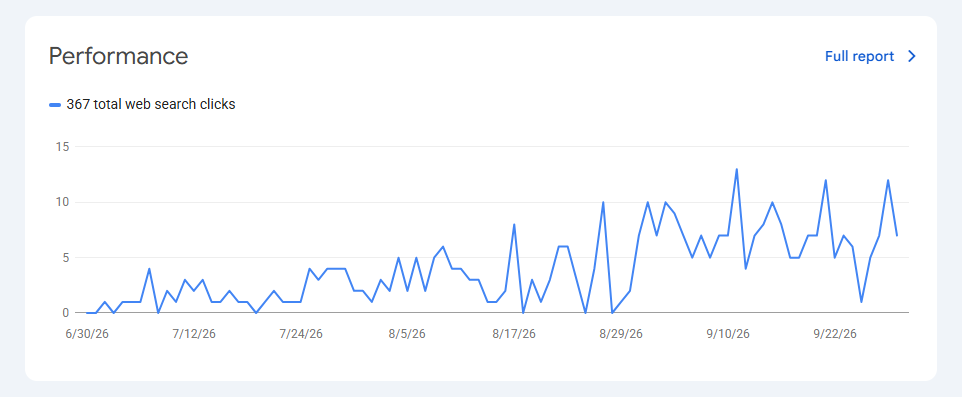
The chart shows visits. What the owner cares about is the phone. And the phone now rings from the website at least once a day.
How many of those calls turned into jobs, he knows, we do not. All we know is this: at the start of October his schedule is booked for the next three months.
(For a firm with one digger, that is a nice problem to have. The next question is whether he needs a second machine.)
In fairness, here is what is not finished yet: the Hungarian version is catching up more slowly than the Serbian one and for now sits below the first page. We are working on it.
What you can take for your own business, even without us
Write down ten questions people ask you on the phone before they say “fine, come over”. How much. How long. Is paperwork needed. Who cleans up afterwards.
Someone is typing each of those questions into Google tonight. If your website has no answer, someone else will answer. And they will get the call.
When this makes sense, and when it does not
This approach works when people search for your service and have questions before they call. Trades, repairs, transport, construction, anything where people ask “how much” before they pick up the phone.
It does not work in a month. Here the first real movement came after two months, and that was on a brand new domain in a trade where competitors barely try. If you need work tomorrow, ads come first.
And it does not work if you will not publish a price. Google already has a thousand pages that say “price on request”. It has no reason to show the thousand and first.
If you do work that people search for, and the only ones who call are those who already have your number, see how we approach web design and SEO, or request a quote.
P.S. In short: a firm with one digger, no website, a Facebook page seen only by people who scroll. Three months later the site brings at least one call a day and the schedule is full until January. Not one Google ad.
P.P.S. The search that brought the site the most visits was not “house demolition”. It was “septic tank depth”. Nobody would have guessed that sitting at a desk. That is why we look at what people type first, and write second.